Monday, 17 December 2007

Movie reviews: Get it together

Film reviewers: can we please, for the love of all that is holy, agree on a single rating system? It seems every time I see a poster or other advert for a film it's plastered with star ratings. But some reviewers use a system of zero to four stars and others use zero to five stars. Can't you see that unless you standardize this, it's meaningless?! If I see a film with four stars, does this mean it's at the top of its scale and so "The best thing ever: miss this and you'll be excluded from every conversation for the rest of time and forced to fake-laugh when people quote lines of dialogue to each other whilst secretly you're dying inside!" or does this mean "Meh..."? Certainly, if I see a film with 5 stars, I can be pretty sure it's in the former category, but that's only until someone starts using a six-point scale and then the whole problem begins again.

As with so many things in life, psychology has the answer. As anybody with even a passing knowledge of the subject will know, to a first approximation our minds can only conceive of around 7 different levels of anything. That suggests that a six-star rating system would be optimal, with zero stars being one of the seven categories. You'll note that this mirrors recent developments in hotel ratings, which clearly proves I'm right.

Now at this point you might argue that because it's possible to award half-stars, we already have 9- and 11-point scales. To which I say: I'M NEVER WATCHING A FILM AGAIN BECAUSE IT'S ALL BECOME TOO STRESSFUL!

Friday, 7 December 2007

And now I battle werewolves

I just got tipped off about the synopsis of a novel called Thunder Moon, by Lori Handeland:

Residents of Lake Bluff, Georgia hope and pray that the small town has returned to normal after the werewolf incidents... However...something is stalking the town; this creature can rip a heart out of a person, but leave no marks on the epidermis. This killer seems to have arrived at about the same time that Dr. Ian Walker came to Lake Bluff. Attracted to the newcomer, she scoffs at his insistence that she contains powerful magic inherited from her Cherokee background. They team up to investigate a supernatural serial killer.

I... I don't know what to say.

Update: And now there's a promotional video! I know it's silly, but it really feels a little odd seeing my name there like that. But at least they accurately portrayed my rock-hard body and raw sexual magnetism...

Monday, 3 December 2007

Diesel-powered crime and mystification

The first work of sociology I ever read was Power, Crime and Mystification by Steven Box. It is an accessible and compelling work in which he argues that criminality is defined in such a way as to maintain the status quo in a society. His thesis is that by defining what is and is not criminal behaviour in very specific ways, the rich and powerful help themselves stay that way at the expense of the poor and powerless. So the same act gets classed as criminal or benign depending on who does it. If a drug addict snatches £50 from me on the street, that is a crime and if the 'thief' is caught they'll likely go to gaol. If, on the other hand, I lose the same £50 because an insurance company took it from me as a premium, knowing they had put some impenetrable clause into the contract for the purpose of not paying out claims... well, don't expect to see anyone in court any time soon, even though the money was deliberately taken from me in just the same way as in the mugging. Indeed, the insurance company's act is much more premeditated than the addict's and so arguably worse.

Other, more dramatic, examples surround homicide. If I stab or shoot somebody in a moment of passion (were I subject to such things), I'll likely be locked up for life. But think how much more time and effort the justice system would make to solve and punish my lone murder (which is unlikely to be repeated) in contrast to the big fat nothing it does to sort out the many many car companies who are selling cars right now which they know will kill people horribly. These deaths are being caused by people's deliberate actions. Are the innocent victims somehow less dead than in the murder? Of course not. Could the deaths be prevented by the criminal justice system? Absolutely, if it wanted to.

I've been pondering these issues recently in the context of public transport. I've already written on more than one occasion about the government's complicity in Britain's public transport woes, but I think the way Train Operating Companies work is a lovely example of Box's principles in everyday life. When I buy a train ticket, I pay a sum of money to be taken somewhere at the scheduled time. If I do not carry out every single part of my obligation - if I pay no fare, or only part of it - the system will make sure I end up in court where I will be fined, publicly humiliated and given a criminal record. The stations and trains are full of posters reminding me of this fact in gloating tones*. But if the Train Operating Company does not carry out its obligation in this deal they are held to have done nothing wrong when they take my money from me. Indeed, they can take my money knowing their service is not available and this doesn't even tiptoe around the herbaceous border of criminality, even though in other circumstances the same behaviour would be called theft, or fraud. The asymmetry of the situation, in which the corporation is favoured over the individual by the criminal justice system for the same act, is staggering when you think about it.

So what's the lesson here? It looks dangerously as though full reordering of our society is needed, so let's steer away from that and instead conclude this: If First's trains ran on time, and weren't mysteriously cancelled in the middle of nowhere half-way through their journeys leaving customers sitting around on wind-blasted platforms on cold nights, passengers wouldn't have time to think about sociological issues and then write about them in public. Yes, there's the moral right there. Jolly well done. Oh, and whoever has my copy of Power, Crime and Mystification, can I have it back please? Ta muchly.

* "Mr P from Whitchurch thought he could save £27 by not paying for his journey to London. We disemboweled his daughter and fed his cat to a crocodile ha ha ha."

Tuesday, 27 November 2007

The People's 50 million: Vote, but don't be fooled

Like every blogger with an interest in cycling, I am now about to exhort you to vote for the Sustrans Connect2 project on the People's 50 Million charity giveaway. If you don't know about this, the National Lottery has £50 million to give to charity, and we can vote for where it goes (presumably to make us feel that we live in some sort of democracy). Anyway, I would suggest you vote for the Connect2 project, which will open up valuable possibilities for off-road cycling and walking all over the country. For example, the plans for the two cities in which I have a personal interest - Salisbury (where I live) and Bath (where I work) - will be magnificent developments, and the Salisbury plans in particular will transform cycling in the city. So vote now - it only takes a moment. And apparently you can do it even if you're not British, so all the people who visit this blog from places like Singapore and the US, you can help too!

Right, now you've done that, let's have a good moan about the whole process. What has happened to our country when a set of highly valuable and important developments - and the Eden Project - are having to fight it out in a vulgar, gladiatorial winner-takes-all combat for a piffling pot of money like this? It is notable that all four projects have some sort of ecological/nature theme, but there is only a small amount of funding and most must lose out. But in a contest to decide where money gets spent in this country, why isn't road-building included? Or Heathrow's expansion? Or the Iraq war? Even if we stick with the transport theme, £50 million is a drop in the ocean of the budget used for building and maintaining highways, or expanding airports and shipping capacity: Why can't we the people choose whether some money gets taken from these budgets to fund ecological work? That way we could fund all four bids. In fact, we could go crazy and give a few million quid to a whole raft of good causes (and the Eden Project). Of course, I've little doubt that in such a straight choice, the British people would choose to have lots more roads and runways now, rather than a peaceful and inhabitable planet in 100 years, but at least it would be their decision and their children would be the ones who would live with its consequences.

But my main concern with this preposterous contest is that it will almost certainly cloud the public and political memories for many years. Funding ecological or non-motorized transport projects three years from now is probably going to be a lot more difficult because as far as the average person and politician will be concerned, those issues were all taken care of during this high-profile event. Indeed, given the publicity that will inevitably surround the winning project, there's the real danger that the three projects that don't get funded (as well as the thousands that were never able to compete) will be perceived as "unpopular" or "unwanted" by the public, and so will be marginalized and in a worse situation that they are now (especially given all the money they will have spent on their bids and publicity). This contest could well prove to be a two-edged sword. Just be careful, is all I'm saying. The average Briton doesn't think about sustainability issues very much as it is, and if they get the impression that it's all been taken care of with a nice big media-friendly quick-fix, changing their behaviour in the future will be a lot more difficult than it is already.

To forestall any flood of emails telling me how great the Eden Project is: it isn't. I will not entertain claims to sustainability or eco-friendliness from an installation built down in a far distant corner of the country which is local only to a handful of cows and which cannot realistically be reached except by car. If they want me to believe they care about the environment they'd have built it near Birmingham, Manchester, Leeds-Sheffield or in the Scottish Central Belt. That way, there would be millions of people who could reach it without travelling a long way, and there would be a useable public transport infrastructure that could bring people from further afield. Tommy-rot.

Wednesday, 21 November 2007

Government's lost database: I'm ready

Given that our government has shown itself so incompetent that they see nothing wrong with giving junior staff the ability to burn a massive secret database full of personal information onto two CDs and bung them in the mail, I along with many others are now living in dread, given that our rulers are obsessed with national ID cards and storing all sorts of other biometrics about British people to foil every form of badness imaginable, from snoring to queue-jumping. As people have pointed out, if the government loses your bank account number and it falls into criminal hands, you can always get a new number. This isn't the case once the government is routinely using fingerprints and iris scans everywhere.

Or is it?! For I can reveal that I have finally perfected Remova-Finga™ technology, allowing quick and easy changes of fingerprints within moments of a government employee doing something so idiotic that it would be disappointing behaviour from a mollusc. I now just need to finish working on iBall-Swappa™ and we're all set to continue living safely under the rule of our mighty leaders.

Thursday, 15 November 2007

The Golden Age that I missed

I recently discovered the terribly talented Canadian cartoonist Kate Beaton. Perhaps my favourite cartoon on her website is her idea of what academic life must be like. As a 21st Century academic, I can't quite express the disappointment I feel in doing my job fifty years too late. Imagine how wonderful it would have been to teach at a university back in the days when one could sit in a seminar room with a group of students, sucking ruminatively on a pipe and watching the smoke play through a shaft of sunlight before eventually wagging the stem at one of the students and saying, "Hum, yes, but what you've overlooked is...". Now that's academic life as it should be.

Damn you, anti-smoking laws - you've ruined the dream! And all because of your "cancer" and "life expectancy". Bah.

Monday, 12 November 2007

Commuting

I'm just watching Dispatches, this week a special documentary about road congestion in Britain. It's a huge problem, causing so many problems to so many people.

So here's a question: if our government is concerned about congestion and pollution - as they certainly claim to be - why the buggery flip do they allow train companies to charge more for travel at peak times than at times nobody wants to travel? If we want fewer cars on the road during rush hour, which everyone agrees we do, the alternatives to driving can't cost extra, and so be disincentivized, at precisely the times they are most needed! Dur! Dur!

Top Gear: Who'd have expected it?

For those who did not see the weekly British televisual car-beatification ceremony that is Top Gear last night, it was rather interesting. The presenters set themselves the challenge of crossing the whole of central London using a car (naturally), public transport, a bicycle and - curiously - a powerboat. Now, we know that in challenges such as this the bicycle always always wins. I was just amazed that such a vehemently pro-car programme showed the bicycle trouncing all the other options. By a large margin. And the car being beaten by every other mode. Who'd have thought it?

What I want to focus on here is Richard Hammond's experience of cycling in London. I wrote here about some of the problems that city has with its cycle facilities, but it was very interesting to see on television somebody's frustration with such magnificent provision as cycle lanes which run for 5 metres then disappear, dumping the rider in traffic. Most interesting was his obvious anger at constantly stopping at traffic lights. The excellent book Bicycling Science (which sits on a shelf next to my desk - can you guess what the next book along is?*) contains this formula:

which describes the power used to ride a bicycle. This formula tells us many things, including that in general, stopping then re-starting a bicycle uses about the same effort as riding 100m. So stopping at just 10 junctions in a journey is as much work as riding a whole extra kilometre. The corollary of this? If your local authority is providing cycle facilities that make cyclists stop unnecessarily - for example, at every single driveway and side-road on a roadside cycle path - then it's just not good enough and you should demand your money back. And as for "cyclists dismount" signs, I just can't swear enough to express my contempt.

* The Bicycle Wheel by Jobst Brandt. If you guessed that correctly then I love you.

Wednesday, 7 November 2007

First: Traumatising Travel

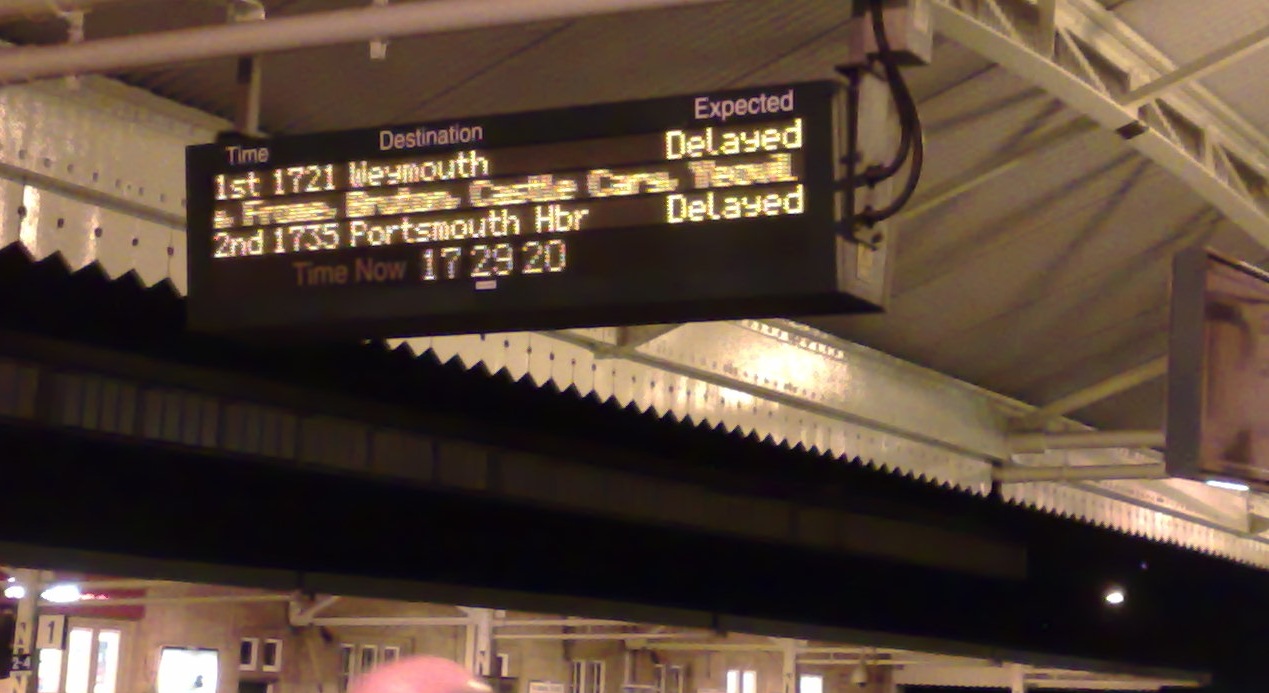
A few weeks ago I wrote about the lamentable arse-fest that is First Group's Portsmouth to Cardiff rail "service", and how they are vastly bloating their profits by running a monopoly as poorly and as cheaply as possible knowing that we have nowhere else to go (with full government complicity). In that entry, written well over a month ago, I mentioned that one of the trains I regularly find myself on has two toilets, one of which had been out of order for weeks. Well, it's now at least three months since that toilet broke - a whole quarter-year in old money - and it still isn't fixed. But my joy has reached new heights, because the one other toilet on that train is now buggered too, as you can see! So for the foreseeable future, there will be no toilets for the hundreds of people on that train! Hoorah for First! Hoorah for Bratislava service at Tokyo prices!

The thing is, I find myself in a real bind. Traditionally, people like myself, who work in transport analysis and so point out that people drive too much, have suggested that people should make more use of public transport. But how can I go on telling people they should use public transport when the monopolistic arse-bags who have seized all the services in this country can't be bothered to uphold their end of the deal by providing useful and non-sub-human services? (In case you don't travel by British train, the toilets are just a poignant symbol- they're not the only problem we face as passengers, but they are damned emblematic.) I was always uncomfortable recommending that people use private, profit-making companies instead of driving, but I could at least cope with this if those companies made some effort. But if their greed, arrogance and complacency have reached such a level that they can't even be bothered to pay a plumber a few quid to unblock a toilet - a sum that is hardly going to dent their £109 million profits all that much - then screw them. That's right: screw them. I'm no longer going to recommend people use these "services", because frankly they aren't a suitable alternative to driving.

So is that it? Ian can't have a wee and so turns his back on the nation's transport problems in a sulk, thereby tacitly supporting untrammeled expansion of private driving? Well, no. The key issue here lies in our definition of "public" transport. At the moment we don't have such a thing. We have "mass transit", run for the benefit of a few Directors and shareholders, but we don't have "public" transport - transport systems operated for the benefit of the public. We have allowed ourselves to fall for the monstrous and evil lie that privatisation and deregulation of public transport offered benefits to the nation. Well, I've lived through the last 25 years. I've seen our public transport degenerate from an affordable and practical solution to personal mobility into a swollen badger's cock of a shambles which is solely focused on profit maximization*. I've travelled all over Europe and sampled public transport in at least a dozen countries, all of which do it better. So I'm here to tell you that privatization and deregulation have not worked. At least not for the British public (the funds of political parties may be another matter). When we have public transport again, I can recommend it. Whilst our services are cynically run as fourth-rate monopolies, with the full encouragement of the government, who award the franchises without even pretending to put the public's interests first, I'll have nothing to do with them.

As for how I personally will travel from now on, I have a plan. Watch this space.

* True fact: when First took over running Bath Spa station, they saw nothing wrong with making the platform staff wear jackets marked "Revenue protection officer". The people who used to be "guards" - i.e., there to look after the customers - were now officially there primarily to make sure First didn't miss a penny of their lovely lovely profits. I mean, even if the staff are there just to assure profits, it takes a very special type of not giving a shit to rub our noses in it like that, doesn't it?

Friday, 19 October 2007

Let's not forget - or lose - what's good about Britain

Life in modern Britain is irritating in many ways, often thanks to greed and incompetence. So sometimes it is helpful to be reminded how good we have it compared to many other places. I've just been reading a report on Minivan News, a Maldivian anti-government news site, about Abdulla Mahir. Mahir is a torture victim, now granted asylum in the UK, and was recently arrested in the UK for throwing an egg at the Maldives president who, he alleges, had him tortured.

“The police treated me very nicely. One officer said to me 'I hope things work out in your favour.'”

“Another policeman was laughing throughout the interview,” Mahir added.

“It was 99% different being under British custody compared to being questioned by Maldivian police. The interview technique was different. I was allowed my lawyer to sit with me throughout the interview and the whole thing was tape recorded. At the end, my lawyer was given a copy of the tape recording. Then a doctor and a nurse came to check that [Maldivian President] Gayoom’s bodyguards hadn’t hurt me.”

It is slightly humbling to see someone so astonished by what we would consider the absolute basics of decent treatment. This is all the more reason we Britons have to be so careful about the relationship between us and the state we, in the final analysis, own. We must, more than ever, guard assiduously against sleepwalking into a state of ever-greater control, suspicion and our government assuming we are all potential criminals as their default position, because it would be a damned shame if our society changed such that the above statement lost its power.

Thursday, 18 October 2007

Bicycles and trucks

The tireless and all-knowing Dave Holladay asked me to co-sign a letter to today's London Evening Standard on how adding an extra set of little side-mirrors to trucks isn't going magically to stop trucks crushing cyclists with depressing regularity, as some people seem to believe. In my correspondence with Dave, I made a point about trucks which I think is important, and which I'd like to record here:

When I see vans and lorries with their "If you can't see my mirrors, I can't see you" signs, I am powerfully inclined to conclude that this simply isn't good enough: if you can't see me and I am in a perfectly reasonable place, your vehicle isn't suitable to be used in an urban environment. Full stop.

And this is the root of it: lorries and other large trucks are designed primarily for the motorway, and the vision they afford the driver is entirely suitable for this, as on a motorway the edges and immediate rear of one's vehicle are largely irrelevant. Lorries should therefore be seen much more like military tanks: great in the environments for which they are designed, but absolutely not suitable for coming into towns and cities. Economics notwithstanding, the "proper" arrangement should be that lorries report to distribution centres at motorway intersections and unload their goods to smaller vans for urban delivery.

So there you have it. Sorry Messrs Tesco, Spencer and Sainsbury - I know you don't like ideas like this. But you can console yourself with the fact your directors' continued affluence has vastly more influence on government policy than road safety, congestion or pollution ever will. And to head off your inevitable counter-point: yes, I will gleefully pay 3p more for each tin of beans I buy if it makes my roads better.

Wednesday, 17 October 2007

Obesity - where's the transport link?

Today obesity is again in the news headlines, the second time this week. The UK government is getting in a right old tizzy about the subject, and rightly so: this is an important issue (although the claim that Britons being fat is as important as global warming is, erm, just a tad anglocentric, don't you think, chaps?).

But why on earth, in all that has been said about this subject, is nobody seeing a role for transport in solving this problem? The facts are that (1) our bodies are not intended to be sedentary and (2) most people drive for most journeys. The majority of journeys under 2 miles are carried out by car, expending practically no energy whatsoever. Getting people to walk and cycle these journeys would make a huge blow against obesity, but it is not being mentioned. Shifting short-distance transport to active modes would change so much and do it simply, but instead we'll probably end up with hamburger-taxes or something equally silly. Sigh.