Showing posts with label transport. Show all posts

Saturday, 16 August 2014

The Walker Anti-Social Parking Scale (WASPS)

Accurate measurement: it's the basis of all science. With this in mind, I present the Walker Anti-Social Parking Scale, or WASPS. How big a nobber is that person who's parked outside your house? Are the drivers of Peterborough worse than the drivers of Manchester? At last we can find out!

WASPS is designed to be simple, so it can easily be employed in the field.

The base WASPS score is one point for each wheel on the pavement or sidewalk.

This base score is then modified based on the following markers:
  • Hazard lights are on +1 point
  • There are yellow or zigzag no-parking lines on the road and the driver thinks parking on the pavement is a genius loophole that avoids these restrictions +1 point
  • More than half the vehicle's width is on the footpath +1 point
  • A no parking sign is flagrantly ignored +1 point
  • The vehicle is in a cyclelane +1 point
  • The driver has folded in the roadside mirror but left the pavement-side mirror sticking out +1 point
  • The pavement is left too narrow for a wheelchair, mobility scooter or pushchair to get past +3 points
  • There is a driveway or other parking space into which the vehicle could and should have been parked +5 points
  • The vehicle belongs to the emergency services and is literally dousing a fire or otherwise saving somebody's life: -10 points

Wow - that's a WASPS score of 14 points, given there was an empty driveway at this house. Beat that 
I hope you find the scale useful - I'll be at home waiting for my Nobel Prize. One day I hope for a government with the balls to crush into a tiny cube any car found to be scoring more than, say, five points.

A handful of calibration images follow so you can practice.
Two wheels plus half-width and wheelchair modifiers - 6 points

Two wheels, cycle lane, double yellows, half-width - 5 points. If there were any justice there would be additional points for terrible taste in cars

Two wheels, double-yellow lines, perfectly legal place to park A WHOLE FUCKING METRE AWAY - 8 points

Two wheels, half-width rule - 3 points

Two wheels, half-width rule, wheelchair modifier and total disregard for no parking sign - 7 points


Wednesday, 6 November 2013

Are you a nanokiller?

I have been intrigued for some time with Ronald A. Howard's idea of micromorts: a way of putting the risks we take in our lives on a human scale. The idea is that one micromort is a 1-in-a-million chance of dying. So, for example, if we say doing a skydive has a risk of 7 micromorts (as that Wikipedia page that I've linked to claims), that means 7 jumps out of each million lead to somebody dying. Or, in other words, if you jump from a plane there's a 7/1,000,000 chance you'll die (assuming you've used a parachute - without the parachute I suspect the chances are far worse). As we'll all die one day, of course, just being alive carries a background risk level of more than 30 micromorts, as the article also explains.


Anyway, I wondered if we might apply a similar principle to road deaths, as a way of making salient a very important point: each time you drive a motor vehicle, there's a small chance someone will die. I've long thought about how, each time I drive, I am effectively killing a tiny fraction of a person because I'm complicit in the overall number of deaths that take place. Today I realised that something analogous to the micromort concept provides a useful way of quantifying this.


So let's find some statistics! The Department for Transport statistics web page reveals that in the United Kingdom in 2012, motor traffic travelled 302.6 bn miles and led to 1754 deaths. Let's do the maths:


  • 302.6 bn / 1754 = 172,519,954.39 miles for each death
  • 1 billion / 172,519,954.39 = 5.8

And so, ladies and gentlemen, I present you with the nanokilling. Every mile you drive, you commit 5.8 nanokillings. Drive 12,000 miles in a year and you've committed 69,600 nanokillings, or 0.0000696 killings.


So clearly, the typical individual is fairly unlikely to kill over the course of their driving career. Let's say someone drives 10,000 miles per year for 50 years. 50 * 10000 * 5.8 = 2,900,000 nanokillings, or 0.0029 killings. This means you'd need to get together with about 344 other people before you could be reasonably sure that, collectively, you've managed to kill somebody.


But that's the thing, isn't it? 345 people isn't really that many. There's probably that many within a few streets of you. And there are a lot of streets in the country, aren't there?


Obviously the nanokilling would need to be recalibrated from time to time as new statistics on numbers of deaths and the amount of travelling that took place to cause them emerge, but of course that's also kind of beside the point. The point is that as long as there is motorized travel and deaths on our roads, the number of nanokillings will never be zero, which means the fundamental point of this article will endure - when we use a motor vehicle, we commit nanokillings. Unless you foreswear motoring (and the products of motoring, and do nothing to push for alternatives) you're to some extent complicit in causing little bits of a death. I know I am, even if I'm not happy about it.

Wednesday, 16 May 2012

Thinking out loud: Are cyclists the new weather?

You find yourself standing next to a stranger, perhaps in a pub or a Post Office queue whilst waiting an unbelievable time for a simple stamp. You decide to strike up a conversation with this person to pass the time. But what do you talk about? The list of topics one can raise with a stranger is quite slim. You can hardly start out with "Isn't the current Prime Minister an incompetent buffoon?" as you risk upsetting their political sensitivities. Sport is also risky - they might support a team you do not. So what's safe? What can you be sure they'll not get offended by? Two topics that never fail are weather and traffic.

"Traffic's bad today, isn't it?" is as safe a conversation opener as you can find. The traffic might be light, but don't worry: this won't go challenged. What else is a safe opening line with a stranger? How about "It's hard to find a parking space, isn't it?" or "Cyclists are a nuisance aren't they? Always riding through red lights and on pavements?" Nod nod nod. Safe. Nobody's going to be offended here. We all agree, just as we all agree that winters aren't what they used to be.

These statements about cyclists, of course, raise the hackles of cyclists a great deal. One only needs to look at yesterday's drama about a survey of red-light jumping behaviour and how it was reported. The old saw about cyclists and red lights is one of a family of statements that are so often repeated I recently suggested somebody should make a bullshit bingo card: red lights, pavements, no tax, no insurance, license plates, helmets, lycra...

And this got me thinking. Yes, these statements are repeated an AWFUL lot, aren't they? I've been hearing them regularly for at least 8 years. They crop up in the comments on almost every article about cycling that gets published online (they'll appear below this, no doubt). Yes, they recur suspiciously often. Hmm...

The thing is, what should we take from these statements? Should we take them as evidence for endemic anti-cyclist feeling? I'm starting to doubt that. It's the fact these statements are repeated SO OFTEN and practically verbatim from a hundred thousand different mouths and keyboards that got me thinking. Because they appear almost as a reflex, and because so many people who don't know one another repeat exactly the same phrases, I suspect that these aren't true opinions; I reckon they are merely memes. They are cultural conventions that have grown up over the past years.

I'd like therefore tentatively to suggest that all these statements such as "Cyclists? They all ride through red lights, don't they?" are fundamentally NOT ABOUT CYCLISTS and should not really be taken as such. I believe they are really a set of social conventions that serve the same role as conversations about the weather: They allow a socially acceptable and safe way to find common ground with strangers. They are (in many people's minds) as uncontroversial as statements about how gravity still seems to be working fine, or how politicians can't really be trusted. They are not intended to challenge or provoke; they are intended to provide comfort through the repetition of a familiar and long-standing ritual, not unlike a religious service.

So perhaps we should not make the mistake of thinking that such statements are the product of considered thought, or really represent people's true opinions. People have not looked into these matters deeply enough to really have deep-seated opinions. If people really studied the weather and climate data they'd stop saying that winters aren't what they used to be. If they studied the traffic behaviour and accident data, they'd stop pointing fingers at cyclists.

Because these beliefs aren't really being examined in depth, people take evidence as it comes rather than going and looking for it, and when this happens one usually sees confirmation bias: the tendency to pay attention to information that confirms what we already believe and ignore information that challenges it. So a person doesn't really notice 25 cyclists stopping at a red light and 50 riding on the road, but spots the one who cuts the light and the one who rides on the pavement because these are what they expect to see.

Of course, the notion that a subgroup of society is a menace could not have taken hold were that subgroup not relatively small and perceived as outsiders. The context in which these social norms arose is fascinating and something I've also thought about, but would be a digression here. The main point I want to explore is that perhaps these statements we see so often are merely conventions that are repeated as part of the social glue that holds society together, and do not necessarily reflect people's true opinions about cyclists.

At first glance, the idea that these incorrect views about cyclists are not deeply examined convictions might suggest they will be easy to change. But if I'm correct in what I'm thinking here, we'd have to suggest the opposite: these views will be difficult to change - they came to hold the position they do in our society because they seemed so self-evident and obvious. Perhaps to challenge the idea that cyclists are all law-breakers is like challenging the idea that winters aren't what they used to be.

Friday, 3 October 2008

A (red) herring in the shower

A few days ago I was asked by Tom Vanderbilt, author of the very readable and interesting book Traffic, to write a piece for his blog summarizing my thoughts on bicycle helmets (thanks, Tom).

Karl McCracken has written some interesting words on the subject as well today. The thing I'd like to pick out of his post is the issue of showers. Like Karl, I have again and again heard people say "Oh, I'd love to cycle to work but we don't have any showers so I can't." Let's have a little look at this, shall we?

When I was doing work on how drivers overtake bicycles, I needed somewhere in Bristol to store my bicycle between testing sessions. I called Sustrans and asked them if they had somewhere I could keep my bike. "Yes, we'll find somewhere," they said. "Just turn up."

When I arrived, where do you think was the one place in the building - a building where everybody cycles to work - that was unused? The shower. And sure enough, that's where the bike was stowed.

Item 2. Last year I attended a meeting at the CTC's headquarters in Guildford. Again, this was a building where everybody cycles to work each day. I saw their shower, and I don't think it had ever been used once.

I think we can learn something from this. Here are two buildings in which the whole staff cycle in every day, and in neither is the shower used. It is clear that showers are a red herring. Like bad weather, they seem a huge concern to people who do not cycle but, after only a little experience, everybody realises it is just not the issue they thought.

So heed my words, people! Of course you'll be a little sweaty the first couple of times you cycle to work because you're not fit! Give it a fortnight and it will no longer be an issue. My workplace is on top of a mountain and I've never showered after getting there. If I have been a little sweaty, simply rubbing it off whilst it's still wet is all that's needed to avoid any smell. And cyclists: spread the word. We need to fight this barrier by showing people that it's just a non-issue if they will only try.

Or could it be that people know showers aren't really an issue, and use a lack of showers in their workplace as a way of justifying a no-longer-acceptable preference for driving? Oooh, what a cynical thought.

Tuesday, 1 July 2008

What's changed, behaviour - or the willingness to talk about it?

The University of Bath, who graciously stick a few quid into my bank account each month, have just completed a large survey of how people get to the campus. The headline finding is that between 2002 and 2008 the proportion of staff driving to the university has dropped from 69% to 58% and the proportion of students driving has dropped from 29% to 12%. Proportions of people catching buses, walking and cycling have gone up.

So does this represent a dramatic shift in behaviour? I hope it does, and that's certainly how the university will perceive it. But this is a campus whose many and massive car parks are groaning, despite being greatly expanded in area since 2002, and where the buses do not appear any more full or numerous than they did 6 years ago. This all leads me to suggest an alternative interpretation for these findings: people who drive are no longer as willing to discuss it as they were in 2002.

If you regularly do something 'wrong', would you take the time to complete an optional survey on that behaviour? How about if you do something perceived as virtuous? It just seems quite likely that these days, a cyclist or pedestrian is more likely to fill in the survey - and thus receive a little glow of satisfaction from talking about their sustainable travel habits - than a driver who will more likely receive a little twinge of annoyance at yet another attack on their habits. So the survey captures a greater proportion of the cyclists and pedestrians than the motorists, which creates an illusory shift in travel behaviour.

Unfortunately, I can't see a solution to this which doesn't involve obliging people to take part in surveys. But as short-distance car-use becomes less and less socially acceptable, we'll have to expect to see more bias of this sort creeping into transport surveys. And we need to be very careful we don't interpret this as people driving less and cycling more!. Mark my words, this mistake will happen.

Of course, if I'm correct in my interpretation, we might try to read these figures as showing that driving to the university is 100 * (1-(58/69)) = 16% less socially acceptable amongst the staff than it was 6 years ago, which is at least a small victory!

Wednesday, 11 June 2008

The family minibus

I have a neighbour who regularly travels with his wife and their two children. To move the four of them around, he bought a minibus with 20 seats.

'Why have you done that?' I asked, choosing my words carefully. 'There are only four of you - wouldn't a car make a lot more sense? It would take up less space and use a lot less fuel.'

He gave me a level look. 'But once every six weeks it's my turn to take my son's football team to their match. I need a vehicle with 20 seats.'

'Er, okay. But why not buy a normal car and just hire a minibus on the odd occasions you need one?' I asked. 'It would be a lot cheaper, and probably easier for you.'

'Oh, who can be bothered with that?' he replied, and stomped off.

Okay, so this neighbour is fictitious, but I've had almost exactly the same conversation with many people, with the only difference being that the numbers are all 5 times lower. There are so many people who buy a car with five seats primarily to move one person around. When challenged, they always point out some achingly unusual event as justification ('What about when I need to take rubbish to the tip?') I mean, what's that? Twice a year? Three times?

As plans for congestion charging force us to think about the consequences of our travel more and more, it is the sheer bone-crunching illogic and irrationality of this thinking that drives me crazy. Cars are fundamentally badly designed in various ways (e.g., their need for huge slurpy soft tyres to stop them flying off the road), and one of their basic design faults is that they take up the same amount of valuable road-space to convey one person as five. As I've mentioned before, people are going to have to realise that if they travel alone 95% of the time, it is better for everyone - including them - if they get a one-person vehicle and hire something bigger on the odd occasion they need more space. It's such a shame that we're going to have to go through masses of congestion and heavy-handed legislation to make people act rationally. Bah.

Tuesday, 27 May 2008

Road Injury Severity Map of England

Here's something curious. Using the Department for Transport's road accident statistics for 2006, I calculated road accident severity figures for each county in England. The DfT's accident figures include a Killed-and-Seriously-Injured (KSI) statistic, which is the count of the most serious road injuries: those leading to... well, death or serious injury. For each county, I divided the number of road accidents with a KSI outcome by the total number of recorded accidents. The reasoning was that the higher this ratio is, the more severe the outcomes of that county's road collisions tend to be and, in one sense, the more dangerous that county's roads are.

The statistics I computed gave figures ranging from just 5.6% of road accidents having KSI outcomes (in Plymouth, where it seems most road accidents tend to end okay) to 23.7% (in North Yorkshire, where almost one-quarter of all road accidents lead to someone being killed or seriously injured). I then normalized these values to lie on a scale from 1 to 100, converted these into saturation levels of the colour red and filled in the counties on a map. Yes, it took a few hours.

The map reveals a few points of interest:

* We have to work in call centres, but at least we don't get squashed too badly - Former heavy industrial areas around Manchester, Merseyside, the West Midlands and the Potteries stand out as having quite low accident severities.

* Leafy suburbs, dead bodies - the affluent south-western corner of Greater London suffers quite a lot of serious road accidents. It's so tempting to make a link to all the SUVs...

* Mad Crazy Viking Berserkers - North Yorkshire and the East Riding. One in four road accidents in North Yorkshire has a serious outcome. My father lives there. I'd like him to move away now.

* Wiltshire and Northamptonshire are really dangerous - I live in Wiltshire! Can everybody take more care please?

* Odd pockets of safety - Plymouth wins here, but there are other counties that stand out from their neighbours: Surrey, Rotherham, Newham in London.

Sadly, these statistics aren't broken down by county for Wales and Scotland. However, overall Wales is at a similar level to Southampton and Coventry, with just under 11% of road accidents having a KSI outcome. Scotland is somewhat worse, and with 17% of all road accidents ending in death or serious injury is similar to Essex and East Sussex.

My hope in doing this was that novel insights might reveal themselves if I looked at the accident data in a new way. I wondered if there would be a North/South split, or patterns that follow motorways. Perhaps the most striking thing to emerge here is the suggestion of more serious road accidents in rural areas. (Most notably, wherever there is a city that has separate figures from the county that surrounds it -- Reading in Berkshire, Leicester in Leicestershire, Poole in Dorset -- the city always has a lower accident severity score than the surrounding county.) This seems on the face of it to support the idea that higher levels of road crowding and reduced speeds are good for reducing the severity of road accidents, although we must also consider other factors specific to rural areas such as twistier roads which give poorer visibility, and possibly higher levels of drink-driving. But then we have to explain why Devon and Cornwall -- perhaps the most rural and twisty-roaded counties -- aren't particularly bad.

Like all good data explorations, this raises more questions than it answers, but I think it shows the value of looking at data in novel ways.

Friday, 23 May 2008

Drinking and driving

During a commercial break on television last night I saw two adverts in quick succession. One was for vodka. Vodka is great stuff, but the advertising can't tell me this. It has carefully to ensure that no images or messages are used which might make me see it as enjoyable, because this could make me, as a blubber-minded member of the public, use it irresponsibly. And in case there's any lingering doubt about how much I'm not supposed to enjoy the vodka, the advert is plastered with the slogan "Drink responsibly" and points me to a website where I can learn how to drink less.

This advert was followed by one from Renault, selling a car which plops out noxious pollutants, is built to exceed the legal speed limit and is quite capable of killing innocent people. It was marketed with lots of exciting images of the car being driven wildly and ended with the slogan "Serious Fun". You can watch it, if you like.

Isn't there an inconsistency here? Alcohol: most people people enjoy it but it can cause harm if abused = constant warnings and can't be marketed as making your life more fun. Cars: although some people enjoy them, they cause harm when used normally = no warnings, and the marketing can promise sex and fun in return for using the product.

Surely the time has come for car companies to go where the drink companies have gone? Renault could have an advert which focuses solely on some minor aspect of the product's design -- the shape of the gearstick, for example, with resolutely no mention of how people might feel when driving the car. It would then display warnings like "Please enjoy the Twingo responsibly". Naturally oil companies should carry similar exhortations in their commercials too. And of course, both types of advertiser should direct consumers to websites where they can be helped to spend less money on the the products of the people paying for the adverts. Just a thought.

Thursday, 22 May 2008

Fuel Prices

Those of us working in transport know that, despite what the public feel, the real cost of motoring is really much lower than it used to be. The Guardian today have an analysis of what fuel really costs, which shows this pretty clearly (and fuel is only one part of the falling cost).

If, like me, your memory extends back as far as the 1970s, you should know all this to be true. Look at car ownership and use prior to... ooh, let's say 1987: a typical person owned a second-hand car and used it fairly infrequently, and the cost was a major factor in this behavioural pattern. Today the same typical person has a brand new black pickup truck and uses it to go everywhere. (Okay, I know not everybody has a black pickup truck, but it does sometimes feel that way. I can't express how much I loathe those ridiculous Nissan and Mitsubishi pickup trucks and the morons who buy them.)*

Sure, part of this is the greater availability of credit, but still: go back 20 years and there was no way the average British working person could have afforded to drive in the manner they do now. And what's the cost of public transport done whilst the cost of motoring has fallen? Yes, you've guessed it...

* Edit: Is anybody else annoyed by the names these moronmobiles have? What sort of inadequate feels the need to drive a vehicle with 'Warrior' or 'Outlaw' slapped on the side? My suggestion: everybody who drives round with 'Warrior' written on their vehicle should be pressed into the army and sent off to Afghanistan, everybody with 'Outlaw' can be lynched and everybody with 'Animal' gets sent to a zoo.

Tuesday, 25 March 2008

David Cameron and cycling's mixed messages

So I suppose I'd better say something about the supposed scandal of David Cameron's cycling. The thing is, all the hullaballoo surrounding his riding really reminds me of some issues I've been mulling for quite some time regarding the terribly mixed messages given to cyclists in this country. Here are a few of them, in no particular order.

  • Cycling down a one-way street is dangerous - unless it happens not to be. Cameron was slammed for this, but I know of various one-way streets which are officially one-way to all traffic except for bicycles, which can go both ways. I use a street like this in Salisbury all the time. So is cycling down a one-way street safe or dangerous?
  • Cycling on the pavement is dangerous - unless there is a small blue sign with a cyclist and a pedestrian painted on it, in which case suddenly cycling on the pavement becomes safe. So is cycling on the pavement safe or dangerous?
  • Filtering up the left-hand side of stopped traffic is dangerous - unless there is an Advanced Stop Line (which nobody can see), in which case it is safe. So is filtering on the left safe or dangerous?
  • Cycling is a healthy and non-polluting travel mode and it is officially supported and promoted - except of course it isn't really officially supported, at least not in a sense whereby the government provides any realistic legal protection, road priority or infrastructure.

I think the clear message here - and particularly with regard to the first three points above - is that a range of cycling activities are terrible and dangerous and a menace to society... unless they get official sanction in a particular place, at which point they magically become safe. Central and Local Government can't have it both ways. They can't on the one hand chastise cyclists for, say, riding the wrong way down a one-way street whilst on the other hand designating one-way streets as open to cyclists as a way of cheaply increasing the amount of cycle provision they have. It is all a question of mixed messages and it's no wonder nobody is happy.

Of course, some people might point out that what we are seeing is a special kind of flexibility for cyclists - places where it has been deemed safe for two-way cycling are opened up and places where it is deemed dangerous are kept one-way, for example. The thing is, if this is the official approach (and I don't believe it is) then this is still a mixed message as the approach is simply not applied consistently.

The current approach, which constantly sends mixed messages about cycling to all road users, fosters danger and resentment - which in turn fosters further danger. What we all need are consistent policies. Is cycling down a one-way street safe or dangerous? If it's safe, make it universal; if it's dangerous, ban it. This is the approach applied to all other road-use, after all. Because despite some of the terrible and ill-informed stereotyping that has been thrown around in the past few days (in a way that would never be allowed about people's other lifestyle choices, I might add), the vast bulk of cyclists are law-abiding and just want to travel safely and efficiently. They don't want to have to constantly travel around asking themselves 'Now is it safe or dangerous to ride here today? Where's the little magic sign that'll stop me hitting the pedestrians...?'

Saturday, 23 February 2008

Car sharing: why can't we think beyond cars?

Car sharing is in the news again as various cities look to ease congestion by reducing the number of cars with only one person in them (four out of every five, according the the BBC report).

The BBC's article includes someone from the AA trotting out the most common objection to car-sharing, which is that it obliges people -- who often won't not know each other well -- to adjust their working patterns so they start and end work at the same time. With the sorts of jobs so many people do, this isn't possible. Therefore, people conclude, car sharing cannot work.

What a staggering lack of imagination! Why on earth don't people see that there are any number of solutions that just don't involve a car at all? It's pretty odd, when you think about it, that people spend so much time travelling alone in vehicles designed to carry five, and which fill up the road just as much to carry one person as their full complement. You wouldn't book five seats in a cinema if you were going there alone. So why don't people consider single-occupant vehicles, such as scooters and motorcycles, more often? Again, it has to be that the car is so amazingly dominant in our collective psyche that their use is totally habitual and alternatives, despite their being plentiful, much cheaper and logically more appropriate, simply never occur to people. So everybody carries on using completely, wildly, infuriatingly inappropriate vehicles to get around and our cities get less and less pleasant and accessible.

Or is it, to build on a conversation I had last night, something to do with labeling? Perhaps most people do not consider a motorcycle, for example, because they simply cannot conceive of the label 'motorcyclist' applying to them? Answers on a postcard, please.

Tuesday, 19 February 2008

Slippery manhole covers get the push, and not before time

Whilst cycling over the years, I've had quite a few close calls with manhole covers. When wet, or polished to a mirror-finish by thousands of passing cars, these can be as slippery as... well, I can't think of a colourful simile: as slippery as something really quite slippery that definitely shouldn't be in the middle of the road, is what I'm getting at.

One of the big problems is that because all manner of pipelines and conduits follow the same courses as the roads, manhole covers are particularly prevalent at junctions: they meet one another underground just as the roads meet one another on the surface. This is a nuisance, as junctions are already a threat to vulnerable road users and we don't need them to be made any worse. Slippery bits at a junction are a particular hazard as the turning forces make cycles and motorcycles ever more likely to fall.

In 2005 I carried out the Oxford and Cambridge Cycling Survey, and the responses we received were full of reports of people coming a cropper on manholes, so I'm very excited to learn that slippery manhole covers could soon be a thing of the past across Europe. But it's really interesting to consider why they have existed as long as they have. The clear explanation is that small slippery spots on the road just don't pose a threat to cars - if one wheel is on a slippery spot, the other three will compensate - especially on modern cars with clever traction controls that will quite literally compensate for the lost grip under one tyre. Since cars aren't affected by little slippery spots, Mr Average Public has never seen them as an issue.

When you ride a single-track vehicle, however, such as a bicycle or motorcycle, I can assure you that small slippery spots on the road are really quite a big deal. It's pretty difficult to escapable the conclusion that the problem would have been sorted decades earlier except that it was a problem only affecting minority road-users. It's one more reason why everybody should have to spend a few months cycling before they are allowed to drive. Yes, my friends: that's the master plan and I'll explain it another time.

Wednesday, 23 January 2008

Car parking: I'll just leave this speedboat here

I've got a really big wooden crate -- it's a little over 4 metres long and just under 2 metres wide -- and it won't fit in my house. I'm the only person who gets any benefit from my having this crate -- indeed, my ownership of the crate is actually bad for you. I didn't really care about the fact I had nowhere to keep the crate when I bought it; I wanted it and so I got it anyway. So now, because it won't fit in my house, I'm just going to leave it in the street. It'll block half of the road, but so what? I need somewhere to keep my crate and that's where it's going.

If you heard me say this, you would quite rightly brand me a selfish bastard who deserves to be beaten soundly with rolled-up copies of the Daily Mail until I learnt a little civic responsibility. But hold fast! What if, instead of a crate, it was a saloon car I was talking about? A car has exactly the same dimensions as my crate, but you'd think absolutely nothing of my saying "I don't have anywhere to store my car and I knew this when I bought it, but I'm just going to leave it in the street where it'll block half the road".

Parking cars is a topic which, more than most, gets people angry (certainly more than the World Bank's policies or the invasion of Iraq, as far as I can see). I've been dwelling on the subject since, about a year ago, I had an email from somebody wanting my expert endorsement for a policy of greater freedom for motorists to park where they like. This got me thinking, and I soon realized that car parking is a nice illustration of the bizarre level of freedom given to motorists. (I turned down the request, incidentally.)

Because here's the question: why should I be allowed to own a car if I have nowhere to store it? I am not permitted the same freedom to store anything else on the road. If I own a caravan, or a speedboat on a trailer, I am obliged to have off-road storage facilities for it. If I want to place a skip outside my house when doing building work I have to take great care that this hazard is brightly lit and removed as soon as possible. These are all relevant comparisons, as skips, caravans and speedboats on trailers are all are more-or-less the same size and construction as a car.

You might at this point be thinking that you pay about £100 a year to tax your vehicle, and that this sum makes cars different from all these other items. This argument is fallacious in so many respects that I think I'll devote a whole post to it soon. For now, let me put it this way: I pay masses of tax every time I buy a bottle of whisky, but I can't thereby expect the State to provide me with a shelf to store it on or a glass to drink it from.

So I'm left unable to see a rational reason why I should be allowed to own a car when I have nowhere to store it, leaving me with no option but to dump it in various bits of the civic landscape. I'd be genuinely grateful for any suggestions.

Edit: To offer one more important comparison, I used to live on a narrowboat on the Kennet and Avon canal. As anybody who has ever tried to buy one with know, it is impossible to own a boat on the inland waterways without either proving you have somewhere to keep it, or issuing a solemn promise that you'll keep on moving indefinitely without leaving it at the canalside. Our canals are a public transport resource just like our roads, but apparently the rules are very different...

Tuesday, 8 January 2008

Don't watch Newsnight on Monday...

...unless you want to risk seeing me talking about Shared Space road design principles. Shared Space is the intriguing idea that traffic management is best handled with as little regulation as possible -- no traffic lights, no road markings, no pavements even -- and it's something I've had my eye on for quite a while as it claims to offer considerable benefits to the more vulnerable users of our roads. Indeed, the approach promises towns in which everybody gets to where they want to go faster and with fewer accidents. It sounds great.

My position, which I hope comes across after the interview is edited, is that Shared Space is a very intriguing idea but that it urgently needs a proper evaluation to tell us whether or not it really works better than the current approach. The problem the Shared Space advocates face is the two curses of road planning. The first curse is that authorities and town planners tend to be very conservative and often won't try new things, sticking to rigid road-design guidelines which are handed down from above and which, in many cases, are essentially based on little more than guesswork.

The second curse is that new developments in road design or usage are hardly ever evaluated properly: when somebody tries something new, it's not often the effect of the innovation is properly measured. So let's have more science and less blind faith: that's my basic argument (and not just as regards road design). BBC 2, 2230 on Monday 14 January.

On a more awe-inspiring note, I entered a great email discussion this morning in which Michael Carley and I decided there really should be a product like Bovril, but pork-based and from Germany. Here's how I imagine the advertising might look...

Monday, 3 December 2007

Diesel-powered crime and mystification

The first work of sociology I ever read was Power, Crime and Mystification by Steven Box. It is an accessible and compelling work in which he argues that criminality is defined in such a way as to maintain the status quo in a society. His thesis is that by defining what is and is not criminal behaviour in very specific ways, the rich and powerful help themselves stay that way at the expense of the poor and powerless. So the same act gets classed as criminal or benign depending on who does it. If a drug addict snatches £50 from me on the street, that is a crime and if the 'thief' is caught they'll likely go to gaol. If, on the other hand, I lose the same £50 because an insurance company took it from me as a premium, knowing they had put some impenetrable clause into the contract for the purpose of not paying out claims... well, don't expect to see anyone in court any time soon, even though the money was deliberately taken from me in just the same way as in the mugging. Indeed, the insurance company's act is much more premeditated than the addict's and so arguably worse.

Other, more dramatic, examples surround homicide. If I stab or shoot somebody in a moment of passion (were I subject to such things), I'll likely be locked up for life. But think how much more time and effort the justice system would make to solve and punish my lone murder (which is unlikely to be repeated) in contrast to the big fat nothing it does to sort out the many many car companies who are selling cars right now which they know will kill people horribly. These deaths are being caused by people's deliberate actions. Are the innocent victims somehow less dead than in the murder? Of course not. Could the deaths be prevented by the criminal justice system? Absolutely, if it wanted to.

I've been pondering these issues recently in the context of public transport. I've already written on more than one occasion about the government's complicity in Britain's public transport woes, but I think the way Train Operating Companies work is a lovely example of Box's principles in everyday life. When I buy a train ticket, I pay a sum of money to be taken somewhere at the scheduled time. If I do not carry out every single part of my obligation - if I pay no fare, or only part of it - the system will make sure I end up in court where I will be fined, publicly humiliated and given a criminal record. The stations and trains are full of posters reminding me of this fact in gloating tones*. But if the Train Operating Company does not carry out its obligation in this deal they are held to have done nothing wrong when they take my money from me. Indeed, they can take my money knowing their service is not available and this doesn't even tiptoe around the herbaceous border of criminality, even though in other circumstances the same behaviour would be called theft, or fraud. The asymmetry of the situation, in which the corporation is favoured over the individual by the criminal justice system for the same act, is staggering when you think about it.

So what's the lesson here? It looks dangerously as though full reordering of our society is needed, so let's steer away from that and instead conclude this: If First's trains ran on time, and weren't mysteriously cancelled in the middle of nowhere half-way through their journeys leaving customers sitting around on wind-blasted platforms on cold nights, passengers wouldn't have time to think about sociological issues and then write about them in public. Yes, there's the moral right there. Jolly well done. Oh, and whoever has my copy of Power, Crime and Mystification, can I have it back please? Ta muchly.

* "Mr P from Whitchurch thought he could save £27 by not paying for his journey to London. We disemboweled his daughter and fed his cat to a crocodile ha ha ha."

Tuesday, 27 November 2007

The People's 50 million: Vote, but don't be fooled

Like every blogger with an interest in cycling, I am now about to exhort you to vote for the Sustrans Connect2 project on the People's 50 Million charity giveaway. If you don't know about this, the National Lottery has £50 million to give to charity, and we can vote for where it goes (presumably to make us feel that we live in some sort of democracy). Anyway, I would suggest you vote for the Connect2 project, which will open up valuable possibilities for off-road cycling and walking all over the country. For example, the plans for the two cities in which I have a personal interest - Salisbury (where I live) and Bath (where I work) - will be magnificent developments, and the Salisbury plans in particular will transform cycling in the city. So vote now - it only takes a moment. And apparently you can do it even if you're not British, so all the people who visit this blog from places like Singapore and the US, you can help too!

Right, now you've done that, let's have a good moan about the whole process. What has happened to our country when a set of highly valuable and important developments - and the Eden Project - are having to fight it out in a vulgar, gladiatorial winner-takes-all combat for a piffling pot of money like this? It is notable that all four projects have some sort of ecological/nature theme, but there is only a small amount of funding and most must lose out. But in a contest to decide where money gets spent in this country, why isn't road-building included? Or Heathrow's expansion? Or the Iraq war? Even if we stick with the transport theme, £50 million is a drop in the ocean of the budget used for building and maintaining highways, or expanding airports and shipping capacity: Why can't we the people choose whether some money gets taken from these budgets to fund ecological work? That way we could fund all four bids. In fact, we could go crazy and give a few million quid to a whole raft of good causes (and the Eden Project). Of course, I've little doubt that in such a straight choice, the British people would choose to have lots more roads and runways now, rather than a peaceful and inhabitable planet in 100 years, but at least it would be their decision and their children would be the ones who would live with its consequences.

But my main concern with this preposterous contest is that it will almost certainly cloud the public and political memories for many years. Funding ecological or non-motorized transport projects three years from now is probably going to be a lot more difficult because as far as the average person and politician will be concerned, those issues were all taken care of during this high-profile event. Indeed, given the publicity that will inevitably surround the winning project, there's the real danger that the three projects that don't get funded (as well as the thousands that were never able to compete) will be perceived as "unpopular" or "unwanted" by the public, and so will be marginalized and in a worse situation that they are now (especially given all the money they will have spent on their bids and publicity). This contest could well prove to be a two-edged sword. Just be careful, is all I'm saying. The average Briton doesn't think about sustainability issues very much as it is, and if they get the impression that it's all been taken care of with a nice big media-friendly quick-fix, changing their behaviour in the future will be a lot more difficult than it is already.

To forestall any flood of emails telling me how great the Eden Project is: it isn't. I will not entertain claims to sustainability or eco-friendliness from an installation built down in a far distant corner of the country which is local only to a handful of cows and which cannot realistically be reached except by car. If they want me to believe they care about the environment they'd have built it near Birmingham, Manchester, Leeds-Sheffield or in the Scottish Central Belt. That way, there would be millions of people who could reach it without travelling a long way, and there would be a useable public transport infrastructure that could bring people from further afield. Tommy-rot.

Monday, 12 November 2007

Commuting

I'm just watching Dispatches, this week a special documentary about road congestion in Britain. It's a huge problem, causing so many problems to so many people.

So here's a question: if our government is concerned about congestion and pollution - as they certainly claim to be - why the buggery flip do they allow train companies to charge more for travel at peak times than at times nobody wants to travel? If we want fewer cars on the road during rush hour, which everyone agrees we do, the alternatives to driving can't cost extra, and so be disincentivized, at precisely the times they are most needed! Dur! Dur!

Wednesday, 7 November 2007

First: Traumatising Travel

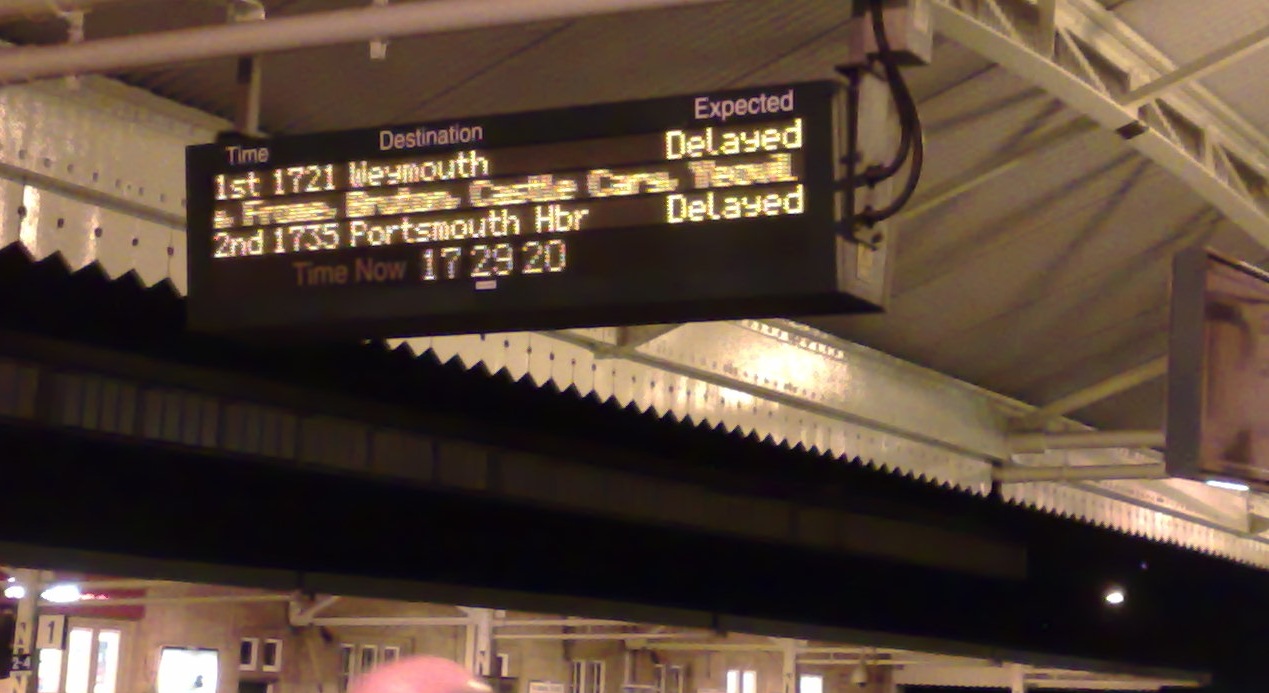
A few weeks ago I wrote about the lamentable arse-fest that is First Group's Portsmouth to Cardiff rail "service", and how they are vastly bloating their profits by running a monopoly as poorly and as cheaply as possible knowing that we have nowhere else to go (with full government complicity). In that entry, written well over a month ago, I mentioned that one of the trains I regularly find myself on has two toilets, one of which had been out of order for weeks. Well, it's now at least three months since that toilet broke - a whole quarter-year in old money - and it still isn't fixed. But my joy has reached new heights, because the one other toilet on that train is now buggered too, as you can see! So for the foreseeable future, there will be no toilets for the hundreds of people on that train! Hoorah for First! Hoorah for Bratislava service at Tokyo prices!

The thing is, I find myself in a real bind. Traditionally, people like myself, who work in transport analysis and so point out that people drive too much, have suggested that people should make more use of public transport. But how can I go on telling people they should use public transport when the monopolistic arse-bags who have seized all the services in this country can't be bothered to uphold their end of the deal by providing useful and non-sub-human services? (In case you don't travel by British train, the toilets are just a poignant symbol- they're not the only problem we face as passengers, but they are damned emblematic.) I was always uncomfortable recommending that people use private, profit-making companies instead of driving, but I could at least cope with this if those companies made some effort. But if their greed, arrogance and complacency have reached such a level that they can't even be bothered to pay a plumber a few quid to unblock a toilet - a sum that is hardly going to dent their £109 million profits all that much - then screw them. That's right: screw them. I'm no longer going to recommend people use these "services", because frankly they aren't a suitable alternative to driving.

So is that it? Ian can't have a wee and so turns his back on the nation's transport problems in a sulk, thereby tacitly supporting untrammeled expansion of private driving? Well, no. The key issue here lies in our definition of "public" transport. At the moment we don't have such a thing. We have "mass transit", run for the benefit of a few Directors and shareholders, but we don't have "public" transport - transport systems operated for the benefit of the public. We have allowed ourselves to fall for the monstrous and evil lie that privatisation and deregulation of public transport offered benefits to the nation. Well, I've lived through the last 25 years. I've seen our public transport degenerate from an affordable and practical solution to personal mobility into a swollen badger's cock of a shambles which is solely focused on profit maximization*. I've travelled all over Europe and sampled public transport in at least a dozen countries, all of which do it better. So I'm here to tell you that privatization and deregulation have not worked. At least not for the British public (the funds of political parties may be another matter). When we have public transport again, I can recommend it. Whilst our services are cynically run as fourth-rate monopolies, with the full encouragement of the government, who award the franchises without even pretending to put the public's interests first, I'll have nothing to do with them.

As for how I personally will travel from now on, I have a plan. Watch this space.

* True fact: when First took over running Bath Spa station, they saw nothing wrong with making the platform staff wear jackets marked "Revenue protection officer". The people who used to be "guards" - i.e., there to look after the customers - were now officially there primarily to make sure First didn't miss a penny of their lovely lovely profits. I mean, even if the staff are there just to assure profits, it takes a very special type of not giving a shit to rub our noses in it like that, doesn't it?

Wednesday, 17 October 2007

Obesity - where's the transport link?

Today obesity is again in the news headlines, the second time this week. The UK government is getting in a right old tizzy about the subject, and rightly so: this is an important issue (although the claim that Britons being fat is as important as global warming is, erm, just a tad anglocentric, don't you think, chaps?).

But why on earth, in all that has been said about this subject, is nobody seeing a role for transport in solving this problem? The facts are that (1) our bodies are not intended to be sedentary and (2) most people drive for most journeys. The majority of journeys under 2 miles are carried out by car, expending practically no energy whatsoever. Getting people to walk and cycle these journeys would make a huge blow against obesity, but it is not being mentioned. Shifting short-distance transport to active modes would change so much and do it simply, but instead we'll probably end up with hamburger-taxes or something equally silly. Sigh.

Saturday, 29 September 2007

Everybody on the train rejoice! Rejoice, I say! *

Excellent news, rail travellers! Last year First Group made £108,800,000 profit on its rail business.

But given that this news is some of the best to hit our nation since VE Day, why is it that amongst all the undoubted joy I feel for First's directors and shareholders, I still find myself wondering why I spent an hour on Thursday evening standing with dozens of other people in a cramped vestibule on one of their improbably short rush-hour trains.

And although I'm obviously thrilled that last year eleven First directors between them trousered £2,108,000, a little joyless part of me can't help wondering why the vestibule I was squashed into contained a toilet - one of only two for the entire trainful of people - that to my certain knowledge has been out of order for at least 8 weeks. Perhaps - and here I go being old Dr Cynical again - it might be related to the fact First Group's executive directors all got company cars, or car allowances, to the tune of £80,000 on top of their salaries, which possibly does not entirely encourage them to travel on their trains themselves. Am I the only one who thinks it odd that the people who run a public transport business award themselves company cars for their own travel? Why, it's almost as if they are disingenuous hounds for whom the services they expect us to use are not good enough! Thank goodness that's not true.

But never mind all this! My regular suffering, and that of my fellow passengers on the Cardiff-Southampton line, is a tiny price to pay for ensuring First Group's directors got average bonuses of £168,750 each last year, a sum which, at slightly less than 10 times the annual salary of a First Great Western guard, is practically a slap in the face for them given how hard they worked for it. All my doubts about privatized rail without any possibility of competition between operators have been laid firmly to rest. I no longer see any impediments at all to our getting people to abandon their cars in favour of public transport, and am frankly mystified why anybody would still drive anywhere these days given they can make the same journey with far more delay, cost and discomfort whilst supporting magnificent businesses like this one. Where's the chuffing bunting?

* We're clamping down on non-rejoicers on our railways. Failure to rejoice could land you with a £10,000 fine and a criminal record. Don't risk it.