Tuesday, 22 April 2008

Ticket touts

We have some odd ideas about ticket touts in this country. Yet again there is talk in the news of banning their activities. People say things like:

[we see] tickets block-booked by people whose sole aim is to sell on at a profit

But why should tickets be so special in this regard? I'm no economist, but surely they are a scarce commodity whose value will be affected by their scarcity? If there are enough people willing -- indeed, eager -- to pay a thousand pounds to watch Led Zeppelin play a concert, then surely that's a valid price for a ticket? Nobody makes a fuss about other rare items being sold at high prices. And here's an amazing secret: well-known shops like Sainsburys, Woolworths and M&S -- they all bulk-buy goods with the sole aim of selling them on at a profit! Lordy! Quick, to the barricades...

Don't get me wrong: I'm not in favour of what is really quite a grubby, squalid and exploitative trade, but let's please be consistent. Either people explain why concert tickets are qualitatively different from any other good traded in the marketplace -- company shares and houses, for example, which are routinely sold at prices bearing no relationship to their worth -- or they shut up and accept the fact we live in a country with a more-or-less laissaiz-faire approach to business. At least, until such time as we establish a Socialist people's empire (with me as its king)...

Thursday, 17 April 2008

The numbers game

Just now, I heard our dog scrabbling around in the next room. I went in to find him with his snout reaching for some papers I had left on the table (his self-appointed mission seems to be to chomp every piece of paper -- and every pen -- in the world: he's clearly taking his inability to read very hard. Either that or, given that he was trying to eat a receipt, he's in the employ of the tax authorities*).

As I ejected him from the room I said 'I want you both to leave that receipt where it is and to get out of this room at once!'. In saying this, it occurred to me how odd the word 'both' is: why do we have this word that captures 'two-ness' but no equivalent words for other numbers? I guess we can say 'just' and 'only' when we're talking about one thing:

I want you just to leave this room

but what about when there are three things? Surely there should be a word like 'thrith'?

I want you thrith to drop that paper, get out of this room, and go to your bed!

And so on, with numbers for four, five, etc. So what's the deal, philologists? Why the hell is there this huge gap in our language? What are you doing when you should be sorting this stuff out?

* IT WOULD NOT SURPRISE ME IF ALL PETS WORKED FOR THE TAX AUTHORITIES, DESTROYING OUR RECEIPTS SO WE HAVE TO PAY MORE TAX

Tuesday, 25 March 2008

David Cameron and cycling's mixed messages

So I suppose I'd better say something about the supposed scandal of David Cameron's cycling. The thing is, all the hullaballoo surrounding his riding really reminds me of some issues I've been mulling for quite some time regarding the terribly mixed messages given to cyclists in this country. Here are a few of them, in no particular order.

  • Cycling down a one-way street is dangerous - unless it happens not to be. Cameron was slammed for this, but I know of various one-way streets which are officially one-way to all traffic except for bicycles, which can go both ways. I use a street like this in Salisbury all the time. So is cycling down a one-way street safe or dangerous?
  • Cycling on the pavement is dangerous - unless there is a small blue sign with a cyclist and a pedestrian painted on it, in which case suddenly cycling on the pavement becomes safe. So is cycling on the pavement safe or dangerous?
  • Filtering up the left-hand side of stopped traffic is dangerous - unless there is an Advanced Stop Line (which nobody can see), in which case it is safe. So is filtering on the left safe or dangerous?
  • Cycling is a healthy and non-polluting travel mode and it is officially supported and promoted - except of course it isn't really officially supported, at least not in a sense whereby the government provides any realistic legal protection, road priority or infrastructure.

I think the clear message here - and particularly with regard to the first three points above - is that a range of cycling activities are terrible and dangerous and a menace to society... unless they get official sanction in a particular place, at which point they magically become safe. Central and Local Government can't have it both ways. They can't on the one hand chastise cyclists for, say, riding the wrong way down a one-way street whilst on the other hand designating one-way streets as open to cyclists as a way of cheaply increasing the amount of cycle provision they have. It is all a question of mixed messages and it's no wonder nobody is happy.

Of course, some people might point out that what we are seeing is a special kind of flexibility for cyclists - places where it has been deemed safe for two-way cycling are opened up and places where it is deemed dangerous are kept one-way, for example. The thing is, if this is the official approach (and I don't believe it is) then this is still a mixed message as the approach is simply not applied consistently.

The current approach, which constantly sends mixed messages about cycling to all road users, fosters danger and resentment - which in turn fosters further danger. What we all need are consistent policies. Is cycling down a one-way street safe or dangerous? If it's safe, make it universal; if it's dangerous, ban it. This is the approach applied to all other road-use, after all. Because despite some of the terrible and ill-informed stereotyping that has been thrown around in the past few days (in a way that would never be allowed about people's other lifestyle choices, I might add), the vast bulk of cyclists are law-abiding and just want to travel safely and efficiently. They don't want to have to constantly travel around asking themselves 'Now is it safe or dangerous to ride here today? Where's the little magic sign that'll stop me hitting the pedestrians...?'

Saturday, 1 March 2008

A mention in the Economist

I just got an email from our university's Press Office to say my work on how drivers' overtaking behaviour gets more dangerous when a cyclist wears a helmet was mentioned in a recent article on risk in The Economist. It's interesting how that project of mine has been viewed and used by different people. One of the main findings was that a behaviour intended to reduce risk (putting on a bicycle helmet) might paradoxically increase one's overall level of risk because drivers react to its presence by changing their behaviour. I've seen this finding used in many discussions -- some people find it a curious datum, others feel it backs up their own experiences, and some people loath my findings, usually because they are starting with the 'common sense' position that bicycle helmets must be a good thing.

But I've also seen that research used in broader contexts. Indeed I've seen it used in relatively extreme right-wing libertarian writing to justify an argument for having no state intervention in people's day-to-day behaviour. It just goes to show that when you do research and put your findings out into the world, you can never be sure exactly what's going to happen to them.

But for all that, I have to say that it's very satisfying that work of mine is being used by people. It's just a shame that any use of one's research by people who are not themselves professional researchers "doesn't count" under our government's Research Assessment Exercise. Academics writing in endless circles about one another's work is "good research"; a grand theory which excites everybody but then proves to be completely bogus after two years is "good research", as there will be lots of papers supporting it, then a second raft of papers slamming it, giving the high number of citations that research assessment focuses on to a large degree. But studies which excite the public, lead to media discussion or even change public behaviour for the better don't count as having had any impact at all -- our research is only "good" if other academics write about it. But we'll moan about that another day. It's far too sunny a Spring day for caviling now. I'm off to walk the dog instead.

Saturday, 23 February 2008

Car sharing: why can't we think beyond cars?

Car sharing is in the news again as various cities look to ease congestion by reducing the number of cars with only one person in them (four out of every five, according the the BBC report).

The BBC's article includes someone from the AA trotting out the most common objection to car-sharing, which is that it obliges people -- who often won't not know each other well -- to adjust their working patterns so they start and end work at the same time. With the sorts of jobs so many people do, this isn't possible. Therefore, people conclude, car sharing cannot work.

What a staggering lack of imagination! Why on earth don't people see that there are any number of solutions that just don't involve a car at all? It's pretty odd, when you think about it, that people spend so much time travelling alone in vehicles designed to carry five, and which fill up the road just as much to carry one person as their full complement. You wouldn't book five seats in a cinema if you were going there alone. So why don't people consider single-occupant vehicles, such as scooters and motorcycles, more often? Again, it has to be that the car is so amazingly dominant in our collective psyche that their use is totally habitual and alternatives, despite their being plentiful, much cheaper and logically more appropriate, simply never occur to people. So everybody carries on using completely, wildly, infuriatingly inappropriate vehicles to get around and our cities get less and less pleasant and accessible.

Or is it, to build on a conversation I had last night, something to do with labeling? Perhaps most people do not consider a motorcycle, for example, because they simply cannot conceive of the label 'motorcyclist' applying to them? Answers on a postcard, please.

Tuesday, 19 February 2008

Slippery manhole covers get the push, and not before time

Whilst cycling over the years, I've had quite a few close calls with manhole covers. When wet, or polished to a mirror-finish by thousands of passing cars, these can be as slippery as... well, I can't think of a colourful simile: as slippery as something really quite slippery that definitely shouldn't be in the middle of the road, is what I'm getting at.

One of the big problems is that because all manner of pipelines and conduits follow the same courses as the roads, manhole covers are particularly prevalent at junctions: they meet one another underground just as the roads meet one another on the surface. This is a nuisance, as junctions are already a threat to vulnerable road users and we don't need them to be made any worse. Slippery bits at a junction are a particular hazard as the turning forces make cycles and motorcycles ever more likely to fall.

In 2005 I carried out the Oxford and Cambridge Cycling Survey, and the responses we received were full of reports of people coming a cropper on manholes, so I'm very excited to learn that slippery manhole covers could soon be a thing of the past across Europe. But it's really interesting to consider why they have existed as long as they have. The clear explanation is that small slippery spots on the road just don't pose a threat to cars - if one wheel is on a slippery spot, the other three will compensate - especially on modern cars with clever traction controls that will quite literally compensate for the lost grip under one tyre. Since cars aren't affected by little slippery spots, Mr Average Public has never seen them as an issue.

When you ride a single-track vehicle, however, such as a bicycle or motorcycle, I can assure you that small slippery spots on the road are really quite a big deal. It's pretty difficult to escapable the conclusion that the problem would have been sorted decades earlier except that it was a problem only affecting minority road-users. It's one more reason why everybody should have to spend a few months cycling before they are allowed to drive. Yes, my friends: that's the master plan and I'll explain it another time.

Friday, 8 February 2008

Sheldon Brown

I've just learnt from the CTC's newsletter that Sheldon Brown has died. If you don't know who Sheldon was, then all I can say is you have probably never repaired a bicycle. For years Sheldon's website has been the first port of call for anybody seeking answers to difficult or esoteric questions about bicycle building and maintenance. And what they found there was practically an encyclopaedia of incredibly well-informed material which Sheldon shared selflessly with the world. There are probably thousands of people internationally who have learnt the difficult art of wheelbuilding at his virtual knee. Surely nobody in the last decade has dealt with a tandem without seeing what he had to say about the subject first.

Sheldon was intelligent, witty and wonderfully eccentric. And with his interest in language he would, unlike my spellchecker, even have appreciated my spelling of 'encyclopaedia' in the last paragraph. He'll be much missed. Thanks for everything.

Wednesday, 23 January 2008

Car parking: I'll just leave this speedboat here

I've got a really big wooden crate -- it's a little over 4 metres long and just under 2 metres wide -- and it won't fit in my house. I'm the only person who gets any benefit from my having this crate -- indeed, my ownership of the crate is actually bad for you. I didn't really care about the fact I had nowhere to keep the crate when I bought it; I wanted it and so I got it anyway. So now, because it won't fit in my house, I'm just going to leave it in the street. It'll block half of the road, but so what? I need somewhere to keep my crate and that's where it's going.

If you heard me say this, you would quite rightly brand me a selfish bastard who deserves to be beaten soundly with rolled-up copies of the Daily Mail until I learnt a little civic responsibility. But hold fast! What if, instead of a crate, it was a saloon car I was talking about? A car has exactly the same dimensions as my crate, but you'd think absolutely nothing of my saying "I don't have anywhere to store my car and I knew this when I bought it, but I'm just going to leave it in the street where it'll block half the road".

Parking cars is a topic which, more than most, gets people angry (certainly more than the World Bank's policies or the invasion of Iraq, as far as I can see). I've been dwelling on the subject since, about a year ago, I had an email from somebody wanting my expert endorsement for a policy of greater freedom for motorists to park where they like. This got me thinking, and I soon realized that car parking is a nice illustration of the bizarre level of freedom given to motorists. (I turned down the request, incidentally.)

Because here's the question: why should I be allowed to own a car if I have nowhere to store it? I am not permitted the same freedom to store anything else on the road. If I own a caravan, or a speedboat on a trailer, I am obliged to have off-road storage facilities for it. If I want to place a skip outside my house when doing building work I have to take great care that this hazard is brightly lit and removed as soon as possible. These are all relevant comparisons, as skips, caravans and speedboats on trailers are all are more-or-less the same size and construction as a car.

You might at this point be thinking that you pay about £100 a year to tax your vehicle, and that this sum makes cars different from all these other items. This argument is fallacious in so many respects that I think I'll devote a whole post to it soon. For now, let me put it this way: I pay masses of tax every time I buy a bottle of whisky, but I can't thereby expect the State to provide me with a shelf to store it on or a glass to drink it from.

So I'm left unable to see a rational reason why I should be allowed to own a car when I have nowhere to store it, leaving me with no option but to dump it in various bits of the civic landscape. I'd be genuinely grateful for any suggestions.

Edit: To offer one more important comparison, I used to live on a narrowboat on the Kennet and Avon canal. As anybody who has ever tried to buy one with know, it is impossible to own a boat on the inland waterways without either proving you have somewhere to keep it, or issuing a solemn promise that you'll keep on moving indefinitely without leaving it at the canalside. Our canals are a public transport resource just like our roads, but apparently the rules are very different...

Tuesday, 8 January 2008

Don't watch Newsnight on Monday...

...unless you want to risk seeing me talking about Shared Space road design principles. Shared Space is the intriguing idea that traffic management is best handled with as little regulation as possible -- no traffic lights, no road markings, no pavements even -- and it's something I've had my eye on for quite a while as it claims to offer considerable benefits to the more vulnerable users of our roads. Indeed, the approach promises towns in which everybody gets to where they want to go faster and with fewer accidents. It sounds great.

My position, which I hope comes across after the interview is edited, is that Shared Space is a very intriguing idea but that it urgently needs a proper evaluation to tell us whether or not it really works better than the current approach. The problem the Shared Space advocates face is the two curses of road planning. The first curse is that authorities and town planners tend to be very conservative and often won't try new things, sticking to rigid road-design guidelines which are handed down from above and which, in many cases, are essentially based on little more than guesswork.

The second curse is that new developments in road design or usage are hardly ever evaluated properly: when somebody tries something new, it's not often the effect of the innovation is properly measured. So let's have more science and less blind faith: that's my basic argument (and not just as regards road design). BBC 2, 2230 on Monday 14 January.

On a more awe-inspiring note, I entered a great email discussion this morning in which Michael Carley and I decided there really should be a product like Bovril, but pork-based and from Germany. Here's how I imagine the advertising might look...

Monday, 17 December 2007

Movie reviews: Get it together

Film reviewers: can we please, for the love of all that is holy, agree on a single rating system? It seems every time I see a poster or other advert for a film it's plastered with star ratings. But some reviewers use a system of zero to four stars and others use zero to five stars. Can't you see that unless you standardize this, it's meaningless?! If I see a film with four stars, does this mean it's at the top of its scale and so "The best thing ever: miss this and you'll be excluded from every conversation for the rest of time and forced to fake-laugh when people quote lines of dialogue to each other whilst secretly you're dying inside!" or does this mean "Meh..."? Certainly, if I see a film with 5 stars, I can be pretty sure it's in the former category, but that's only until someone starts using a six-point scale and then the whole problem begins again.

As with so many things in life, psychology has the answer. As anybody with even a passing knowledge of the subject will know, to a first approximation our minds can only conceive of around 7 different levels of anything. That suggests that a six-star rating system would be optimal, with zero stars being one of the seven categories. You'll note that this mirrors recent developments in hotel ratings, which clearly proves I'm right.

Now at this point you might argue that because it's possible to award half-stars, we already have 9- and 11-point scales. To which I say: I'M NEVER WATCHING A FILM AGAIN BECAUSE IT'S ALL BECOME TOO STRESSFUL!

Friday, 7 December 2007

And now I battle werewolves

I just got tipped off about the synopsis of a novel called Thunder Moon, by Lori Handeland:

Residents of Lake Bluff, Georgia hope and pray that the small town has returned to normal after the werewolf incidents... However...something is stalking the town; this creature can rip a heart out of a person, but leave no marks on the epidermis. This killer seems to have arrived at about the same time that Dr. Ian Walker came to Lake Bluff. Attracted to the newcomer, she scoffs at his insistence that she contains powerful magic inherited from her Cherokee background. They team up to investigate a supernatural serial killer.

I... I don't know what to say.

Update: And now there's a promotional video! I know it's silly, but it really feels a little odd seeing my name there like that. But at least they accurately portrayed my rock-hard body and raw sexual magnetism...

Monday, 3 December 2007

Diesel-powered crime and mystification

The first work of sociology I ever read was Power, Crime and Mystification by Steven Box. It is an accessible and compelling work in which he argues that criminality is defined in such a way as to maintain the status quo in a society. His thesis is that by defining what is and is not criminal behaviour in very specific ways, the rich and powerful help themselves stay that way at the expense of the poor and powerless. So the same act gets classed as criminal or benign depending on who does it. If a drug addict snatches £50 from me on the street, that is a crime and if the 'thief' is caught they'll likely go to gaol. If, on the other hand, I lose the same £50 because an insurance company took it from me as a premium, knowing they had put some impenetrable clause into the contract for the purpose of not paying out claims... well, don't expect to see anyone in court any time soon, even though the money was deliberately taken from me in just the same way as in the mugging. Indeed, the insurance company's act is much more premeditated than the addict's and so arguably worse.

Other, more dramatic, examples surround homicide. If I stab or shoot somebody in a moment of passion (were I subject to such things), I'll likely be locked up for life. But think how much more time and effort the justice system would make to solve and punish my lone murder (which is unlikely to be repeated) in contrast to the big fat nothing it does to sort out the many many car companies who are selling cars right now which they know will kill people horribly. These deaths are being caused by people's deliberate actions. Are the innocent victims somehow less dead than in the murder? Of course not. Could the deaths be prevented by the criminal justice system? Absolutely, if it wanted to.

I've been pondering these issues recently in the context of public transport. I've already written on more than one occasion about the government's complicity in Britain's public transport woes, but I think the way Train Operating Companies work is a lovely example of Box's principles in everyday life. When I buy a train ticket, I pay a sum of money to be taken somewhere at the scheduled time. If I do not carry out every single part of my obligation - if I pay no fare, or only part of it - the system will make sure I end up in court where I will be fined, publicly humiliated and given a criminal record. The stations and trains are full of posters reminding me of this fact in gloating tones*. But if the Train Operating Company does not carry out its obligation in this deal they are held to have done nothing wrong when they take my money from me. Indeed, they can take my money knowing their service is not available and this doesn't even tiptoe around the herbaceous border of criminality, even though in other circumstances the same behaviour would be called theft, or fraud. The asymmetry of the situation, in which the corporation is favoured over the individual by the criminal justice system for the same act, is staggering when you think about it.

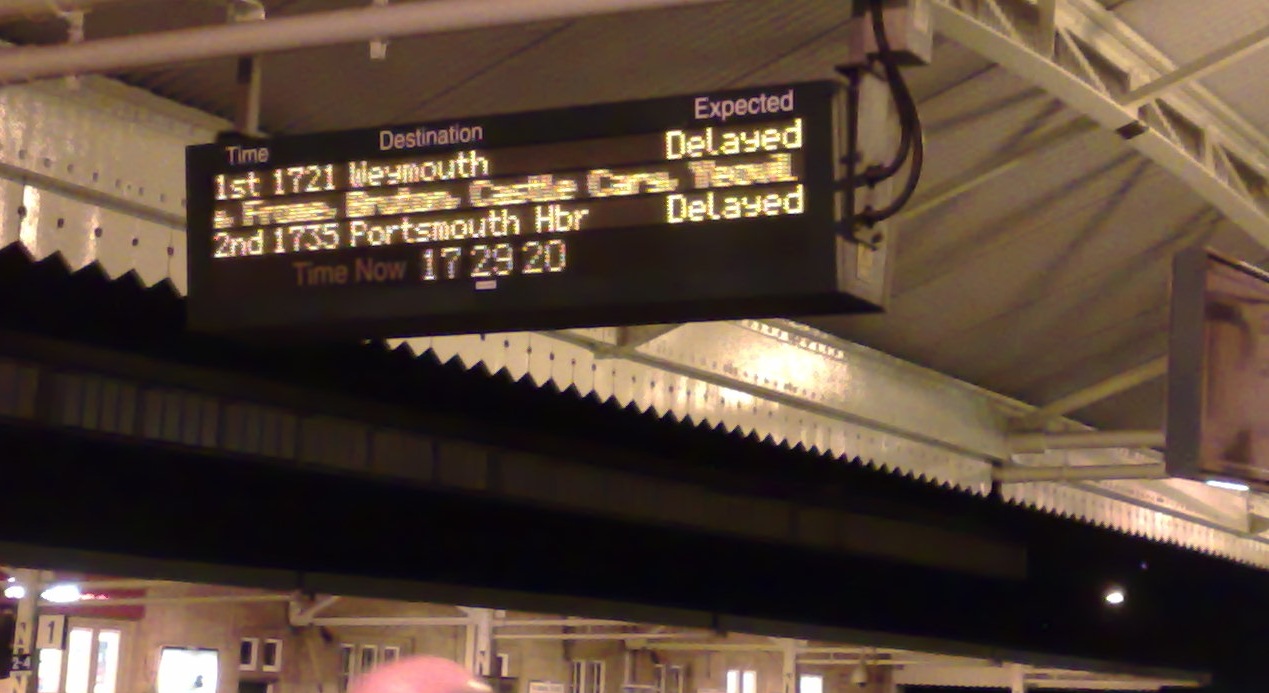
So what's the lesson here? It looks dangerously as though full reordering of our society is needed, so let's steer away from that and instead conclude this: If First's trains ran on time, and weren't mysteriously cancelled in the middle of nowhere half-way through their journeys leaving customers sitting around on wind-blasted platforms on cold nights, passengers wouldn't have time to think about sociological issues and then write about them in public. Yes, there's the moral right there. Jolly well done. Oh, and whoever has my copy of Power, Crime and Mystification, can I have it back please? Ta muchly.

* "Mr P from Whitchurch thought he could save £27 by not paying for his journey to London. We disemboweled his daughter and fed his cat to a crocodile ha ha ha."